Programming Languages for AI Agents
Python, Javascript, or Rust?

As AI agents move from experimental prototypes to production systems, a critical question emerges: Are we using the optimal development tools, or do we need to upgrade our foundation before building these digital architectures?
The conventional wisdom among your 10X developer is clear - there’s no universal “best” language for agent development. Python remains the ecosystem leader, benefitting from its rich AI/ML libraries and rapid prototyping capabilities. However, languages like Rust, Go, and Node.js are carving out significant niche for specialized agent workloads where performance, concurrency, or deployment constraints matter most.
In 2024, Python overtook JavaScript as the most popular language on GitHub, while Jupyter Notebooks skyrocketed, both of which underscore the surge in data science and machine learning on GitHub. But the landscape of AI agent development spans multiple programming languages, each with distinct advantage for different use cases.
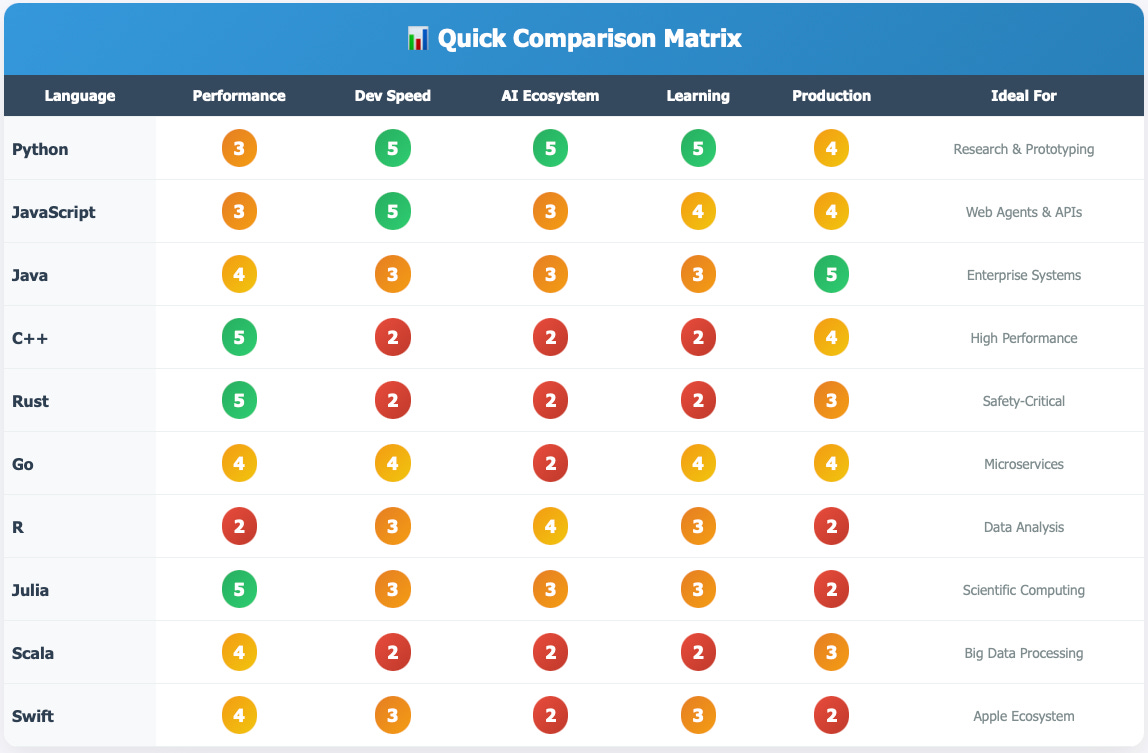
Here is a quick comparison matrix and scroll down for detailed analysis →
Python - Best Overall for Agent Logic and LLM Integration
Ideal for rapid prototyping, general-purpose AI agents like cognitive/planning agents, multi-agent orchestration, academic and research prototypes.
✅ Pros:
Huge ecosystem for ML, LLMs (TensorFlow, PyTorch, scikit-learn, NumPy, pandas) and Agent frameworks (LangChain, CrewAI, Autogen, OpenAgents, Phidata)
Rapid prototyping, simple syntax and easy integration with APIs and services
Tight integration with tools like OpenAI, Hugging Face, Pincecone, Weaviate, etc.
Large community and extensive documentation
Excellent debugging and testing tools
🚫 Cons:
Not ideal for high-concurrency or low-latency systems (due to GIL: Global Interpreter Lock)
Higher memory consumption
Slower runtime performance than compiled languages
Rust - Best for Secure, High-Performance Agent Infrastructure
Ideal for agent backends, vector search engines, low-level agent infrastructure, blockchain-based agents and high-performance systems.
✅ Pros:
Memory safety and concurrency without garbage collection
Great for long-running, performance-critical agents (like crawlers, API daemons, or simulation engines)
Used in agent containers (e.g., ReALM, inference runtimes, embeddings servers)
Modern language features and growing ecosystem for AI/ML
🚫 Cons:
Slower development cycle, steep learning curve
Fewer AI/ML libraries
Longer compilation time
Limited talent pool
Still maturing for AI applications
Go (Golang) - Best for Concurrent Multi-Agent Systems
Ideal for real-time distributed agents, micro services agents, inter-agent communication and task distribution.
✅ Pros:
Built-in concurrency (goroutines), simplicity, fast compile times
Good for building scalable agent-based microservices or distributed agent backbones
Simple, clean syntax with built-in HTTP server capabilities
Fast compilation and deployment
🚫 Cons:
Limited AI ecosystem/ML library ecosystem and smaller community for AI development
Basic error handling
Not ideal for mathematical computations
JavaScript / TypeScript (Node.js, Deno) - Best for Web-Integrated Agents
Ideal for Web UIs, Browser-based LLM agents and Plugins.
✅ Pros:
Useful for browser-based agents, extensions, or agents embedded in web apps
Fast event-driven concurrency
Strong asynchronous programming model
Fast development cycle
Native JSON handling
Easy deployment to cloud platforms
Growing AI library support
🚫 Cons:
Limited traditional ML library support
Single-threaded nature can be limiting
Less mature AI/ML ecosystem compared to Python
Not designed for heavy computation
Memory management challenges
Java - Scalable, Secure, Verbose and Production-proven
Enterprise agents, large-scale distributed systems, Android-based agents
✅ Pros:
Excellent performance and stability
Strong enterprise ecosystem
Robust concurrency support
Platform independence (JVM)
Extensive testing frameworks
Strong security features
Great for microservices architecture
🚫 Cons:
Verbose syntax slows development
Limited AI/ML library ecosystem
Steeper learning curve
Heavier resource consumption
Less agile for rapid prototyping
C++ - Great for Speed and Control, but high Complexity
High-performance agents, embedded systems, real-time applications, edge computing
✅ Pros:
Maximum performance and efficiency
Fine-grained memory control
Excellent for embedded systems
Direct hardware access
Mature ecosystem for systems programming
Predictable performance characteristics
🚫 Cons:
High development complexity and steep learning curve
Longer development time
Memory management challenges
Limited high-level AI libraries
Prone to security vulnerabilities
Julia - Niche but powerful for scientific agents
Ideal for scientific modeling agents and high-performance numerical applications
✅ Pros:
High performance + simplicity for mathematical modeling
Strong in scientific computing and differential programming
Good parallel computing support
Combines ease of Python with speed of C
🚫 Cons:
Smaller community and ecosystem
Limited support for LLMs and agents
Fewer learning resources
Still maturing as a language
R - Great for Statistical Analysis but Narrow Scope
Good for Data Science applications, Statistical analysis agents and research-focused agents
✅ Pros:
Excellent for statistical computing
Rich ecosystem for data analysis
Strong visualization capabilities
Designed for data manipulation
Great for research and analysis
🚫 Cons:
Limited general-purpose programming capabilities
Performance issues with large datasets
Memory management challenges
Steep learning curve for non-statisticians
Limited production deployment options
Scala - Good for Big Data agents
Ideal for big data agents, Apache Spark applications, functional programming approaches
✅ Pros:
Excellent for big data processing
Functional programming paradigms
Strong type system
JVM performance benefits
Good for distributed computing
🚫 Cons:
Complex syntax and steep learning curve
Limited AI-specific libraries
Smaller community
Longer compilation time
Swift - Good for iOS/macOS agents
iOS/macOS agents, TensorFlow Swift applications
✅ Pros:
First-class iOS/macOS integration
Growing ML support with TensorFlow Swift
Modern language features
Strong performance
Apple ecosystem advantage
🚫 Cons:
Limited to Apple platform
Small AI/ML ecosystem
Limited cross-platform support
Relatively new for AI development
Final Verdict:
LLM orchestration and unmatched AI ecosystem: PythonHigh-performance agents with memory efficiency: RustReal-time agent networks with simple deployment: GoWeb-embedded agents and async superpowers: JavascriptScientific modeling, Statistical computing agents: Julia/ RBattle-tested, Enterprise-grade tooling: Java
In 2025, the best programming language for your agentic workflow will have to balance performance, adaptability and community support. While Python leads with its vast AI libraries and ease of use, Rust and Go offer compelling advantages in speed and concurrency. Ultimately, the best choice depends on your agent’s complexity, deployment needs, and long-term scalability. As agent architectures mature, polyglot systems may become the norm, blending strengths form multiple languages.
There are some exciting emerging languages and startups innovating in the agent AI and systems programming space, such as Mojo, Val, Jai and Modular, Outerbounds, Martian, which I will cover in detail in another blog post.
Till then, may your threads never deadlock, and your agents always vibe!
The views expressed are those of the author and do not necessarily reflect the views of any investment firm or portfolio company.